Frost, Volts and the Long Walk Home: Winter Trolley Maths for UK Golfers
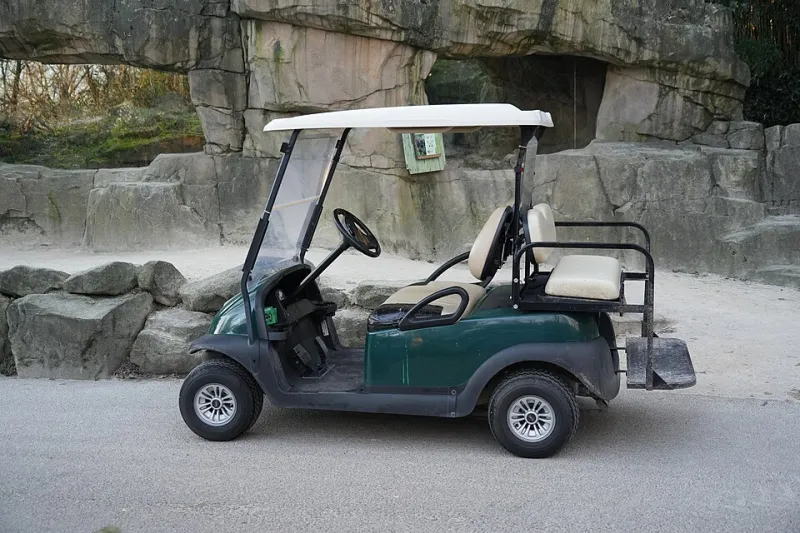
Photo: AgainErick, CC BY-SA 4.0, via Wikimedia Commons
It's the 14th. The light is flat, the ground is still crunchy in the shade, and your trolley display has shed two bars in the time it took to walk from the 13th green. By the 15th it's beeping. By the 16th you're dragging it, and by the 17th you're carrying a bag you specifically bought a trolley to avoid carrying.
Nothing has failed, technically. This is just winter doing what winter does to batteries — and most UK golfers meet it every year without ever changing how they charge, store or plan around it.
Cold is a range problem, not a breakdown
Lithium packs don't lose their charge in the cold. They lose their willingness to give it up. As cell temperature drops, internal resistance rises, voltage sags under load, and the trolley's protection circuit reads that sag as a flat battery and shuts down. Uphill holes, wet fairways, thick rough and a bag loaded with waterproofs and a flask all raise the current draw — which is why the failure so often arrives on the toughest walk of the back nine rather than on the flat second.
Which explains the great mystery of winter golf: the battery that died on the 15th is mysteriously fine when you plug it in at home. It wasn't empty. It was cold and being asked for more amps than it could find.
That also tells you the fix isn't a bigger battery in most cases. It's a warmer one, and less load on it.
The charging habits quietly costing you holes
A few things worth auditing before your next winter medal:
- Charging in the garage. If your charger lives on a cold concrete wall and the pack sits at 2°C, the charge is slower and often terminates early. Charge indoors, at room temperature, ideally the night before rather than a week before.
- Topping up after a wet round. A damp battery and a damp connector are a poor combination. Dry the terminals, let the pack reach room temperature, then charge.
- Leaving it on the charger for days. Modern chargers cut off, but cheap ones trickle. Unplug when the light goes green.
- Ignoring a part-charge. If you finish a round on two bars and don't touch it until the next game, you're starting the day with less headroom than you think — and cold eats headroom first.
Your car boot is the enemy
The single most common cause of a mid-round shutdown isn't age or abuse. It's a battery that spent the night at -4°C in the boot of a car parked on a driveway.
Bring it inside the night before. On the morning, transport it in the footwell with the heating on rather than in the boot or on a cold rear seat. An insulated bag — the sort sold for camera gear for about £15 — does more for your winter range than most people realise. And never charge in the car.
Spare battery maths versus a new trolley
Here's where the honesty comes in. A new electric trolley in 2026 sits somewhere between £400 and £700 depending on how much tech you want. An OEM replacement lithium pack is typically £90–£140, and a compatible third-party pack can be found nearer £70 if you're careful about connectors and warranty.
If your trolley's frame is straight, the motor is quiet, the bearings aren't grumbling and it folds without a fight, then the only thing that's failed is range. Replacing the whole machine to solve a range problem is expensive theatre.
Do the cost-per-round sum. A £90 spare over 40 winter rounds works out at £2.25 a round. Spread over two winters and you're under a quid. Compare that with the £450 you'd drop on a new trolley that will also see sub-5°C mornings and behave identically in year three.
There's a cheap tactical version of this too: keep the older pack as your front-nine pack and run the newer one from the 10th. Sounds fussy. Takes four seconds. Keeps you off the carry.
When walking is simply the smarter play
A spare battery is a bargain compared with a new trolley. It is not a bargain compared with shouldering a 2.5kg stand bag for a nine-hole knock.
Ask yourself honestly how many winter rounds you actually play 18 holes. If the answer is three or four, and the rest are nine-hole evening loops or short-course hits, the trolley is dead weight before you've even switched it on — and the battery is a maintenance task you're doing for no return.
Worth checking your club's frost policy too. Plenty of UK courses restrict or ban trolleys when there's ground frost to protect the turf, which means the battery you agonised over isn't even making the trip.
A five-minute pre-medal routine
- Pack charged indoors, 24 hours out, not a week.
- Battery travels in the warm part of the car.
- Check the display reading when you arrive — note the voltage, not just the bars.
- If the forecast is under 3°C, put the spare in the car. Not in the bag. In the car, warm.
- If it dies mid-round, log the hole and the conditions. Three rounds of that data tells you whether you need a pack or a plan.
None of this is glamorous. But the difference between a 3-handicap and a 12 in January is rarely the swing. It's who's still pushing their bag up the 16th with something left in the tank.