Sand, Trees and Slope: How to Read a Parkland Hole Before You Pull a Club
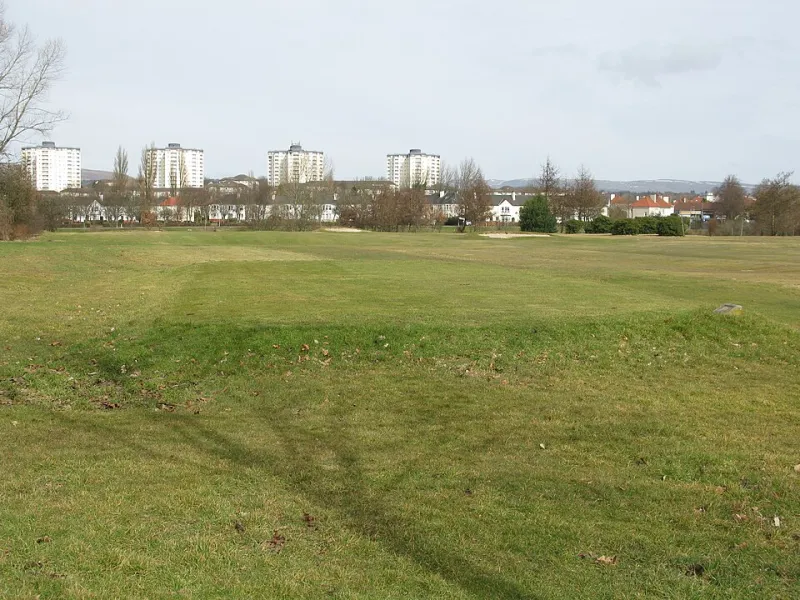
Photo: G Laird, CC BY-SA 2.0, via Wikimedia Commons
Most of us in Britain cut our teeth on parkland. Clay underfoot, oaks and limes down both sides, a bunker that seems to have been dropped in by someone who never actually played the hole. Then we go and read course-management advice that assumes firm turf, open fronts and a wind off the sea, and quietly try to apply it to a 380-yard par four in Nottinghamshire in November. It doesn't fit. So let's read parkland on its own terms.
The good news is that parkland is the most legible golf there is. Links asks you to guess at bounce and borrow and which way the wind will shove a ball at the top of its flight. Parkland tells you the answer in advance, in sand, trees and slope — you just have to stop treating those things as decoration and start treating them as instructions.
Bunkers Are Placed, Not Scattered
A fairway bunker is almost never an accident. Somebody stood on the tee with a plan and put it exactly where the average member's drive lands, or where the aggressive line wants to go, or both. That means the bunker isn't really a hazard to avoid — it's a marker telling you where the hole does and doesn't want you.
The useful question isn't "can I carry it?" It's "what is the bunker guarding?" Stand on the tee and look for the widest patch of short grass. Nine times out of ten, the bunker sits on the direct line to the flag and the wide patch sits off to one side. The hole is offering you a number. Take it and you'll have a longer club in, but a flat lie and a clear look at the green. Take the bunker on and you'd better be certain, because a parkland bunker in winter is often a half-shot penalty, not a full one — wet sand, a steep face, and a stance that has you standing in a puddle while the ball sits on high ground.
Also read the cross-bunkers at 200–230 yards from the tee. In summer they're a decision. In a wet British November the ball doesn't run, so a carry that measures 205 in the yardage book might need 220 in the air. If you're not sure, the honest answer is usually: lay back, take the extra club, and let the bunker do nothing but look at you.
The Tree Line Is the Real Fairway
On parkland, the fairway is a fiction. The actual playing corridor is defined by the canopy. Stand behind your ball, look up, and find the gap in the trees — not the middle of the short grass, the gap. If a branch hangs five metres into your eyeline from the right, your target has just moved left, whether the fairway mowing pattern agrees or not.
Trees change the shape of the hole in ways that a stroke-saver never will. A lone oak on the corner of a dog-leg isn't there to be hit; it's there to make you choose between a cut around it and a shorter club under it. Same with a line of poplars down the left of a par five — they're effectively a wall, and the hole is asking you to work the ball off them rather than at them.
A quick habit worth building: before you choose a club, pick the tallest tree on the side you're least likely to miss towards. Aim at the gap, and let your natural shot shape drift away from the trees rather than into them. If your stock ball is a draw, don't aim down the right edge of a tree-lined fairway and hope. Aim at the middle and watch it come back.
Green Surrounds Are a Map of Your Misses
This is where parkland gives you the most free information and where most club golfers ignore it entirely. Walk up to any green and look at the shape of the ground around it. Mounds on one side and a hollow on the other is not landscaping. It's a diagram of where the architect expects you to miss, and which miss he's willing to forgive.
The low side of a green is usually the friendly one. Balls feed down into the hollow, gather, and leave you a straightforward chip up the slope to a pin you can see. The high side is usually the punishment side — a mound that kicks your ball away, a steep drop, a bunker face you can't get over. So when you're standing in the fairway with a seven iron, you're not really choosing between the flag and the fat of the green. You're choosing between two misses. Pick the one that leaves you putting, or chipping uphill.
A specific parkland trap: the green that slopes front-to-back with a bunker short-left. Everyone aims at the flag, comes up a groove short, and finds sand — because the front of that green is a false front and the bunker is the collection point. On that hole, the correct play is often one club more and a target ten feet past the flag. Long is safe; short is not. It takes nerve to aim past a pin, and it takes about three weeks to stop caring once you see the scores.
Three Ordinary Holes, Read Aloud
A Midlands par four, 385 yards, bunker right at 230. The bunker covers the aggressive line into a narrow neck. The wide grass is left, and the left side gives you an open angle into a green that's guarded short-right. Read: driver at the left edge of the bunker, or a 3-wood at the middle of the fairway. Miss: left is fine, right is sand.
A Surrey parkland par three, 165 yards, mounds left, hollow right. Flag is back-left. Mounds left will kick a pulled ball away into rough; the hollow right collects and feeds back towards the green. Read: aim at the right half of the green and let the ground bring it in. Miss: right, always right.
A Yorkshire par five, 505 yards, poplars down the left, cross-bunkers at 240. The poplars squeeze the tee shot and the cross-bunkers sit exactly where a good drive lands. Read: hybrid or long iron to 220, then a decision on the second. Miss: right, away from the trees, even if it's in the light rough.
The 60-Second Pre-Shot Read
Before you pull a club, do four things in under a minute.
- Find the bunker that's nearest the line to the flag. That's the guarded line.
- Find the widest grass. That's the offered line.
- Look at the green surround. Name your miss out loud — "right of the flag, uphill chip" — and commit to it.
- Adjust for the season. Wet parkland plays longer than the card says, and a cold ball flies shorter than your summer number.
That's it. No yardage book required, no course planner, no app subscription. Parkland is generous with information; it just doesn't shout. Read the sand as a signpost, the trees as a wall, and the slopes around the green as a map of where you're allowed to be wrong — and you'll find that half the shots you used to lose on these holes were never really about the swing.