When Your Course Shrinks: How to Keep a Winter Score That Still Means Something
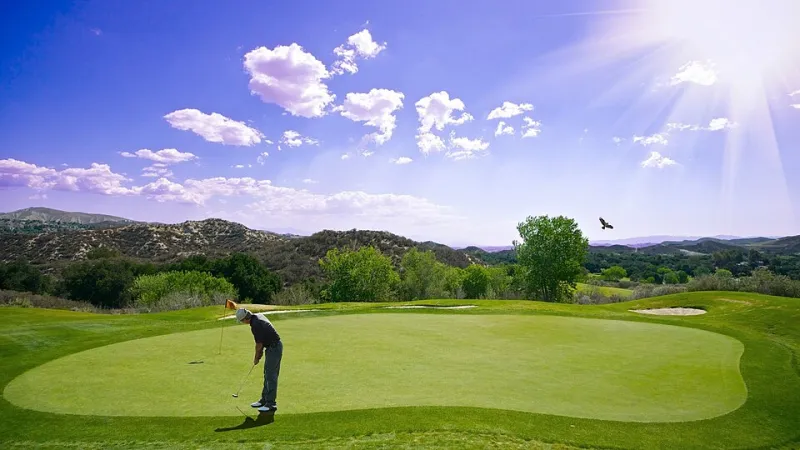
Photo: Janbaby, CC0, via Wikimedia Commons
The course you're actually playing
There's a moment every November when you stand on the first tee and realise the course has been quietly edited. The tee is 30 yards forward. The flag you can see is a pole stuck in a patch of fairway that's been mown a bit shorter than the rest. The bunkers are marked ground under repair. Your 6,400-yard parkland track is now something closer to 6,000, and three of the greens you spent all summer learning are wrapped in frost covers.
That's the temporary green tax. It doesn't show up on your bank statement, but it changes the game. The par threes are shorter, the par fours are sometimes driveable, and the putting surfaces bear as much resemblance to your summer greens as a driving range mat does to a links fairway. The score you write down is still a score, but it isn't the same score you'd write in July. Pretending otherwise is how winter golf makes people miserable.
The useful move is not to ignore the tax. It's to adjust your targets, your clubs and your expectations so the number on the card still tells you something true about how you're playing. This is a guide to doing exactly that in the winter of 2026-27.
Club selection: control beats distance
Cold air is denser than warm air, so the ball doesn't fly as far. That's the standard winter warning. But it's only half the story, because your course has also moved the tees forward and shrunk the target. The two effects often cancel each other out. A 150-yard par three in July might be a 7-iron. In January, with the tee 20 yards forward and the temperature at 6°C, it might still be a 7-iron. Don't automatically club up just because your breath is visible. Check the yardage, check the wind, and hit the club that actually gets you there.
What does change is the value of control. Temporary greens are often smaller, slower or bumpier than the real thing, and they're frequently surrounded by areas that aren't quite fringe and aren't quite fairway. A low, running 5-iron into a temporary green is a lottery. A higher, softer shot that lands in the middle and stops is a much better bet. Favour clubs you can flight down slightly and land softly. If you've been carrying a 4-hybrid all summer and never quite trusting it, winter is the time to use it off the tee on shortened par fours. Position beats power when the course is already giving you yards for free.
Target choice: the middle is the pin
On a normal green, aiming at the flag is a reasonable default. On a temporary green, the flag is often just a marker in a field. The actual safe zone might be a circle of mown grass 15 feet across, or a patch of fairway that drains better than the rest. Your job is to find the middle of that safe zone and hit it. Not the pin. Not the back edge. The middle.
This sounds obvious, but it's amazing how many winter scores blow up because someone tries to flag a temporary green from 170 yards. A two-putt from the middle is a good outcome. A three-putt from the fringe is not a disaster. A chip that runs eight feet past the hole is fine. Treat every temporary green as a target that rewards conservatism, and you'll make fewer doubles without feeling like you've stopped trying.
The same logic applies to your tee shots. On a par four that's been shortened from 410 to 340 yards, the driver might bring a ditch or a copse into play that wasn't reachable in summer. A 5-wood or hybrid to 220 yards leaves a wedge and keeps the big number off the card. The scorecard doesn't care that you could have hit driver. It cares that you didn't make a 7.
Expectations: set a winter baseline
Your summer handicap is not a winter target. The course is different, the conditions are different, and the temporary greens are not qualifying surfaces for most handicap purposes. Check with your club, but in the UK, rounds on temporary greens usually aren't acceptable scores for WHS. That means your winter score is for you, not for the system.
So set a winter baseline instead. Play three rounds in the same conditions and write down the same things each time: fairways hit, penalty shots, number of double bogeys or worse, and how many short-game attempts you gave yourself. Ignore greens in regulation. On a temporary green, GIR is a meaningless stat. You can be on the surface in regulation and still be 40 feet from a flag that's stuck in a different postcode.
After three rounds, you'll have a number that means something. Maybe your winter baseline is 84, with two penalty shots and four doubles. That's your par. Beating it is progress. Matches it is fine. Shooting 92 because you tried to play the summer course that isn't there is not a useful data point.
Putting and chipping on surfaces that don't cooperate
Temporary greens are often slower than real greens, and they can be bumpy. The instinct is to hit putts harder. Resist it. A firm putt on a bumpy surface is a coin flip. A lag putt that finishes two or three feet away is a skill. Aim to leave yourself a tap-in, not to hole a 20-footer. If the surface is really rough, consider putting from the fringe more often. A putter is less likely to dig into a soft lie than a wedge, and it keeps the ball rolling on the ground rather than flying through the air.
Chipping is the same story. Soft ground means less run. Firm ground means more. Read the lie, pick the club that gets the ball on the surface quickly, and accept that you're not going to chip in as often as you do in summer. The goal is a putt you can make, not a highlight reel.
The mental tax is the real tax
The biggest cost of temporary greens isn't the yardage. It's the frustration. You hit a good shot, it lands on the temporary green, and the ball rolls off because the surface is shaggy or sloped or both. You three-putt from 12 feet because the grass is inconsistent. You feel like you're being punished for doing the right thing.
You are, a bit. That's winter golf. The players who score well in these conditions are the ones who accept the tax and stop arguing with it. They aim at the middle, they take the club that lands softly, they lag the putt, and they move on. They don't try to force a summer score out of a winter course.
The takeaway
Your course shrinks in winter. That's fine. Adjust your targets, club for control, set a winter baseline, and track the stats that actually tell you something. The score on the card won't be comparable to your summer best, but it can still be useful. It can tell you whether your tee-shot decisions are improving, whether your short game is holding up, and whether you're making fewer doubles. That's a winter score worth keeping. The temporary green tax is real, but you don't have to pay it twice.