Turf Doesn't Lie: The Seaside Booking Test That Separates Links From Lawn
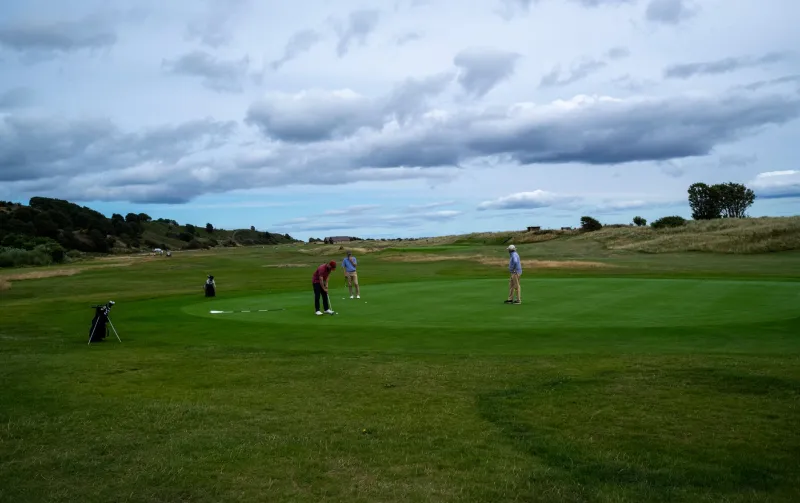
There's a particular kind of British golf disappointment, and it arrives at about 8.04am on a Saturday. You've driven two hours, paid £85, walked to the first tee past a sign that says something about a 'classic seaside experience', and then your opening drive lands with a sound like a wet sponge hitting a tiled floor. No bounce. No release. Just a small, sad splat and a ball sitting six inches from its pitch mark.
You are not playing links golf. You are playing parkland with a sea view, and you have paid roughly forty quid over the odds for the privilege.
This is one of the quietest rip-offs in British golf, and it survives because the word 'links' has been allowed to mean 'near water' rather than 'built on sand'. It's a turf product, not a scenery product. Once you accept that, the booking decision gets a lot simpler.
What you're actually paying the premium for
A real links costs more to play because it delivers three things a parkland can't fake: firm ground, fast drainage and wind as a permanent tactical feature. That's it. That's the product. The marram grass and the lighthouse are marketing.
When you pay a links green fee in 2026, you're buying the ability to land a 7-iron forty feet short of a green and watch it trundle on. You're buying a course that's open on 3 January when everything inland is on temporary greens and a trolley ban. You're buying a round where the wind changes the club in your hand three times a loop.
If none of those things happen, you've bought a view. And views, frankly, are free at plenty of coastal car parks.
Test one: does the ball run?
The cheapest audit in golf. Before you hit a shot, drop a ball from waist height onto the first fairway. Then throw one along the ground, underarm, and watch what it does.
On genuine links turf the thrown ball keeps going, ticking and releasing like it's on a bowling green. On parkland-by-the-sea it stops within a few yards, sitting up in soft grass. That single test tells you more than any website blurb. Do it on the 1st and again on the 10th, because some courses are half and half — sand near the coast, heavy clay on the inland holes, and you'll feel the difference underfoot within about thirty seconds.
Test two: look at what's growing
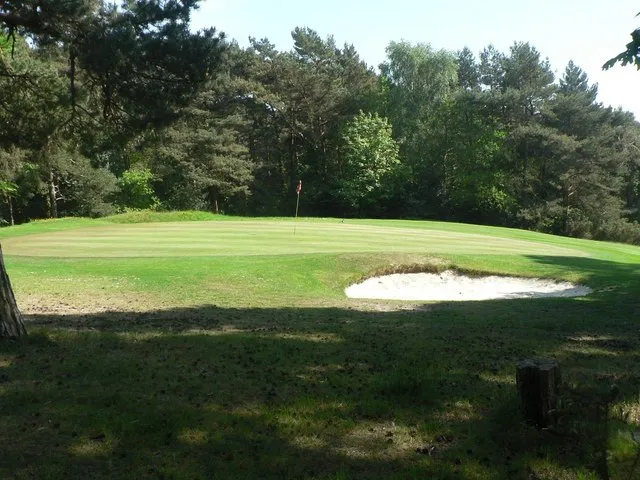
Fescue and bent are the real links grasses. They're fine-bladed, they're a duller olive-green than the emerald you see on telly, and they cope with drought by going dormant rather than dying. Rye and poa are the parkland grasses — darker, thicker, hungrier for water.
Three quick tells:
- The rough. Wispy, stringy, bleached at the tips? Links. Broad-leafed and lush? Not links.
- The divot. A fescue divot is thin and dusty, almost like a scrape of turf. A rye divot comes up in a dark clod that sticks to your wedge.
- The colour. Uniform deep green everywhere in August means irrigation, which means soft. Genuine links goes tawny at the edges and nobody apologises for it.
Test three: read the winter, not the summer
This is the one that separates honest courses from optimistic ones. Anyone can look magnificent in June. The links question is what happens in February.
Go to the website and find the winter course status page. Then ring the shop and ask one question: how many temporary greens did you use last January, and was there a trolley ban?
A true links will say something like 'none' and sound faintly insulted. A pretend links will say 'five, on and off, depends on the rain' — which is a perfectly respectable answer for a parkland, just not one worth a coastal premium. If the winter page is missing entirely, treat that as an answer too.
Test four: walk the routing, not the holes
Links courses are compact because the land was never much use for anything else. They tend to run out and back, they loop tightly, and the walk from a green to the next tee is usually short and often shared.
If the course map shows you crossing a road, a car park and a practice ground between the 7th green and the 8th tee, you're on an estate course that happens to face the sea. That's not a crime — but estate courses are priced as estate courses everywhere else in the country. Ask yourself why this one isn't.
Test five: is the wind actually allowed to play?
On a real links, wind is a design element. There are multiple tee options to change angles, low-run approaches are viable, and the clubhouse will talk about prevailing winds the way a parkland talks about its trees.
A useful marker: does the card or the pro shop mention a wind chart, or a second set of tees used when it blows? If the whole place is set up for one condition — still air, soft greens, dart-throwing — the wind off the sea is scenery, not strategy.
The pre-booking checklist
Before you commit, run these five:
- Green fee comparison. Price it against a known good inland course of similar standard. If it's £25–£40 more, you're paying for turf. If it isn't delivering turf, don't pay.
- Winter record. Ask the temporary greens question. No answer is a bad answer.
- Grass species. Ring and ask what the fairways are. Fescue-dominant is the green light.
- Routing. Check the map for green-to-tee proximity and road crossings.
- Photography honesty. If every promotional shot is of the same one hole, that's not a links, that's a photo.
Word traps worth noticing
'Links-style' is the loudest warning sign in British golf marketing. Style means imitation. Nobody describes a genuine links as 'links-style' any more than a real heathland course calls itself 'heathland-esque'.
Watch for 'sea views from the 12th', 'tree-lined fairways with coastal glimpses', and any sentence containing both 'parkland' and 'breathtaking'. All of these can describe a lovely day out. None of them justify a links price.
Where the money is actually well spent
If you want real links golf in this country, you can still get it — and the shoulder months are when it makes financial sense. November to March, genuine links courses drain, stay open and often drop their rates, while the pretend ones close their winter greens and charge the same as ever.
The alternative is to stop chasing the word. A good heathland course in Surrey or Berkshire will give you firm turf, running golf and a proper test of your trajectory control, and it'll be honest about what it is. A well-run parkland at £45 is a fine afternoon. The problem is never the parkland. The problem is the £85 green fee attached to it because you can smell the sea from the 14th.
Drop a ball on the first fairway. If it doesn't run, you'll know what you've bought.